
what do they listen to?
Start with the music your child already listens to, then find the instrument that makes that sound.
There is no ranking of instruments, but four questions will narrow it down.
Answer these before you buy anything.
Start with the music your child already listens to, then find the instrument that makes that sound.
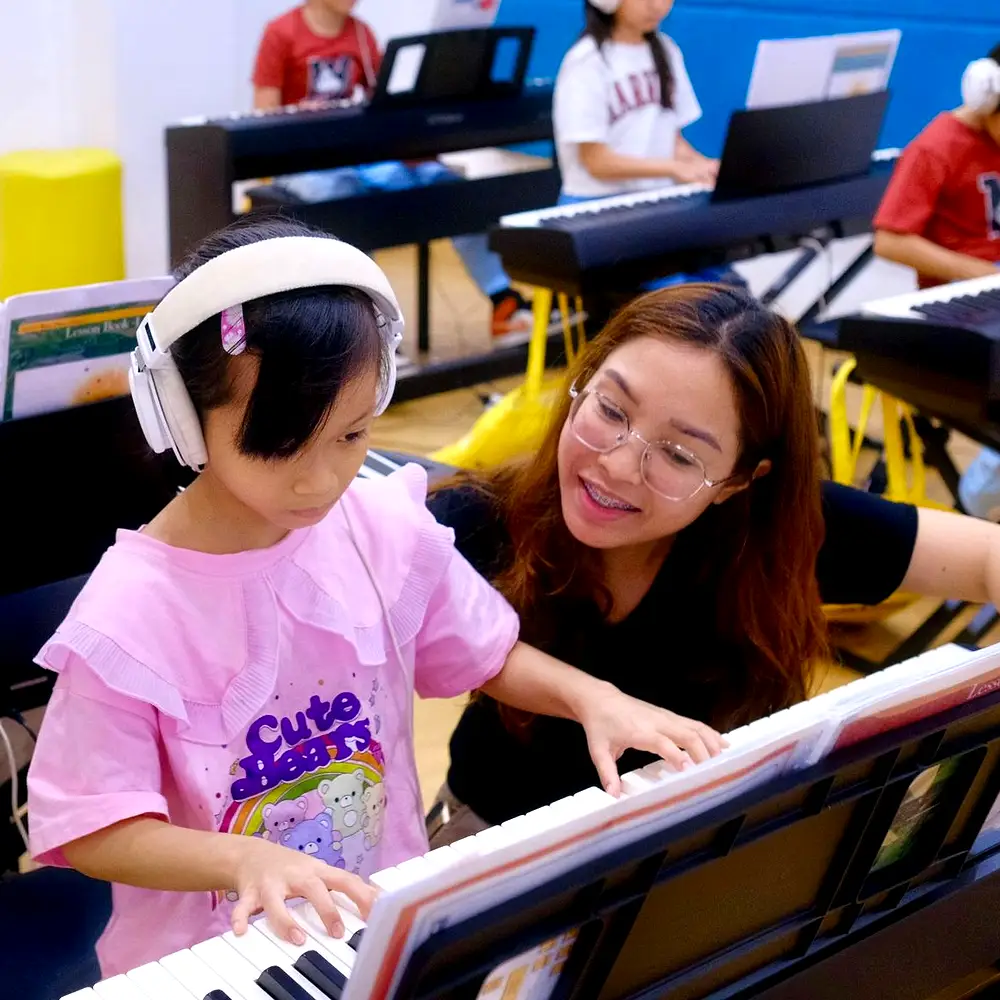
A digital piano or electronic drums can be played with headphones. A violin, brass and an acoustic drum kit cannot.
Instruments have real physical requirements.
Piano and drums reward a beginner within weeks. Violin and brass take longer before the sound is pleasant.
Ask the School Desk to check size and readiness at a trial lesson before you buy.
The most forgiving start for a six or seven year old, and the instrument most families here start with. The note is there as soon as the key goes down. The hands need to span a few white keys, and the feet need support from a bench or box. A digital piano with headphones solves the noise problem.
Immediately satisfying and physically demanding. The child needs legs long enough to work both pedals from a properly set stool. Volume is the main practical issue at home, and hand technique can be practised on a pad with headphones.
Guitar needs fingertip strength and a short-scale instrument for small hands. A full-size steel-string guitar is punishing for a six-year-old. Expect sore fingertips for two or three weeks.
The honest hard one. The first six months go into holding the instrument and the bow correctly and learning to hear whether a note is in tune. Violins come in fractional sizes, measured from the child's neck to their palm, not guessed from their age. Ask a teacher to check the size before you buy.
Brass and most woodwind want front teeth that have finished changing and a decent lung capacity. Ask the School Desk whether your child is ready before you book.
No size requirement and nothing to buy.
Group classes are a low-commitment start, especially for younger children who are not sure yet. Junior Piano Group and Junior Guitar Group are for ages 6 to 17, at $13.50 per lesson with 10 lessons included.
Private lessons are one teacher and one child: $23 for 30 minutes, $33 for 45 and $43 for 60. Most beginners start with 30 minutes a week.
Switching later is not a failure. Plenty of students start on one instrument and move to another after a year or two, and the reading, rhythm, ear training and practice habit all transfer. Full prices are on the lesson fees page. The long version of this advice is in choosing which instrument to start on.
Tell the School Desk your child's age and what they like to listen to. They will suggest a trial that suits.